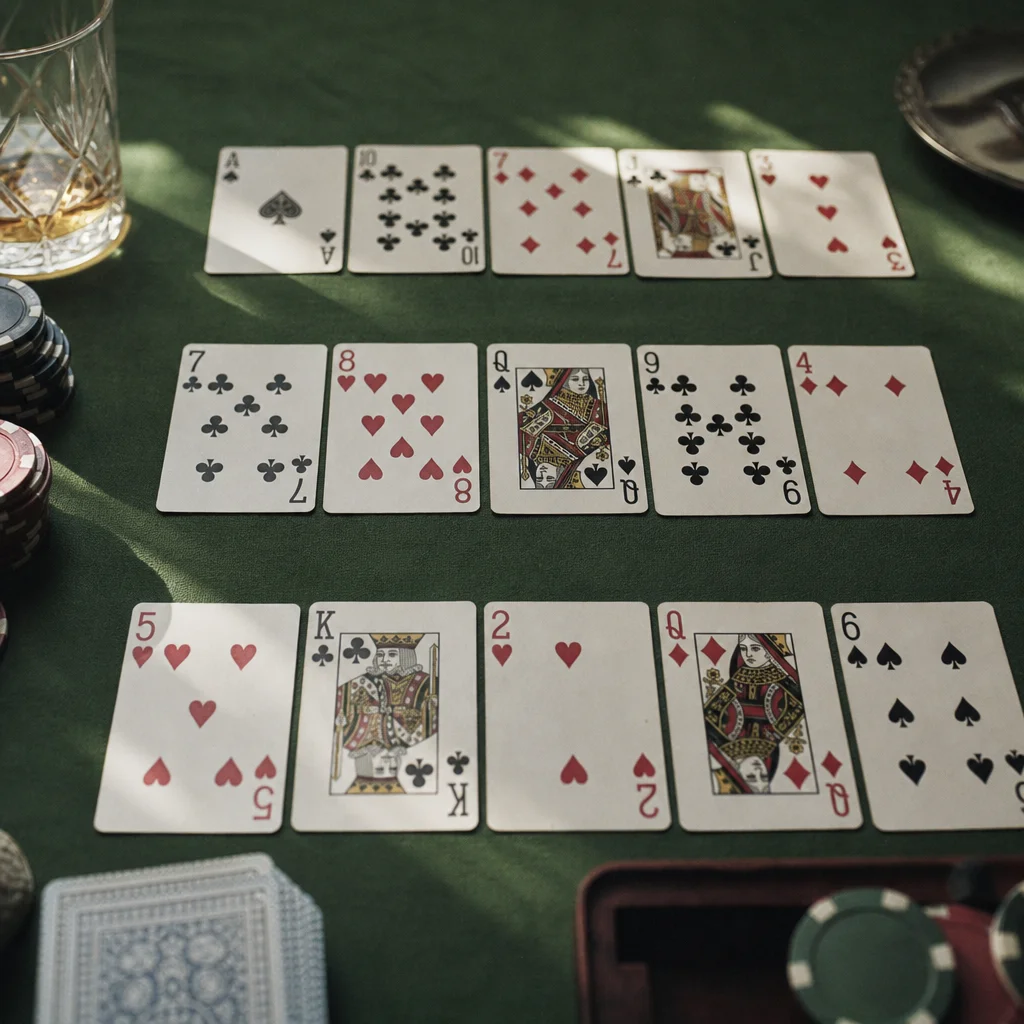

Mixed Games Poker: Rotations, Formats and Where to Start
On a typical mid-stakes online series, roughly one in ten tournament entries now sits in a mixed-game event rather than a single-variant one. That's mixed games poker in a nutshell: instead of playing Hold'em for four hours straight, you rotate through several poker variants at fixed intervals, often without seeing the same game twice in a row. If you've already got a handle on one variant and you're wondering what a HORSE or 8-Game table actually asks of you, this poker variants guide is a reasonable place to see the games side by side before diving into a rotation.
What Mixed Games Poker Actually Means
A mixed poker game is any format that combines two or more distinct poker variants into a single session, switching between them on a schedule rather than letting players choose. Instead of everyone agreeing to play Omaha for the night, the table (or the software) decides when the game changes, and everyone adapts on the fly. This isn't a niche curiosity — it's how a meaningful share of high-stakes live cash games and a growing set of tournament series are structured, precisely because it rewards all-around skill over single-variant specialization.
I've watched strong no-limit Hold'em players sit down at their first mixed table and struggle in ways they didn't expect. It's not that the individual games are harder — it's that you can't lean on years of pattern recognition in one format. You're forced to apply theory rather than memory, which is why serious players use mixed games as a training ground.
How the Rotation Actually Gets Scheduled
Rotations run on one of two clocks: hands or time. A hand-based rotation switches games every 8, 10, or 16 hands — common online, since software can track the count precisely. A time-based rotation switches every 30 or 60 minutes instead, which is more typical in live casino settings where dealers are counting a clock rather than a hand counter. Either way, the order of games repeats in a fixed cycle, so once you've seen one full rotation, you know exactly what's coming next and can plan your session around it.
Table software and tournament directors publish the rotation order in advance for exactly this reason — a mystery rotation would just create arguments about what's dealt next. For the hand-by-hand mechanics of the most common eight-game rotation specifically, that detail belongs on our dedicated HORSE poker breakdown rather than here; this page stays focused on the rotation layer itself.
Common Poker Games You'll See in a Rotation
Not every mixed game uses the same lineup, but a handful of popular poker games show up again and again. Below is a comparison of the four you'll meet most often, since knowing the shape of each before you sit down saves you from learning it under pressure.
| Game | Card Structure | Betting Style | Skill Emphasis |
|---|---|---|---|
| Texas Hold'em | 2 hole cards + 5 community | No-limit or limit | Aggression, position |
| Omaha Hi-Lo | 4 hole cards + 5 community | Usually limit or pot-limit | Hand-reading, nut selection |
| Seven Card Stud | 7 cards, no community cards | Fixed-limit | Memory, exposed-card reads |
| Razz | 7 cards, lowball ranking | Fixed-limit | Patience, low-hand discipline |
Who Plays Mixed Games — and Why
Three groups tend to gravitate toward mixed tables: grinders looking for softer overall fields, since fewer players specialize across every variant; students of the game who use rotation play to expose gaps in their skill set; and live-casino regulars who find single-variant sessions repetitive after thousands of hours. None chase the same thing, but all end up at the same rotation.
Starting Point Tip
Getting Started Without Overwhelming Yourself
Don't try to learn five different poker games at once. In my experience, the fastest path in is picking two variants you already half-know, playing a rotation limited to just those two, then adding a third once switching stops feeling disruptive. Low-stakes online rotations are forgiving places to do this, since the downside of a clumsy Razz hand is small while you're still building pattern recognition.
Worth noting: some players lean on real-time assistance tools to get through unfamiliar variants faster, and NZT Poker is one example of software built around in-hand suggestions rather than pre-session study. That said, most rooms and club apps that host mixed rotations prohibit real-time assistance in their terms, so it's a trade-off between speed and account risk — not a free shortcut. A solver-based trainer used away from the table carries none of that risk. For the canonical rule set, see H.O.R.S.E..
Curious How the Individual Variants Compare?
A side-by-side look at hand structure and betting across the games you'll meet in rotation.
See the Poker Variants GuideDisclosure: This page contains affiliate links. We may earn a commission at no extra cost to you.
Related Articles
Frequently Asked Questions
What is mixed games poker?
What are mixed poker games?
What does the term 'mixed games' mean in poker?
How does a single mixed poker game work?
What are some common poker games?