
PokerStars Review 2026: Mixed Games, HORSE & Draw Tables
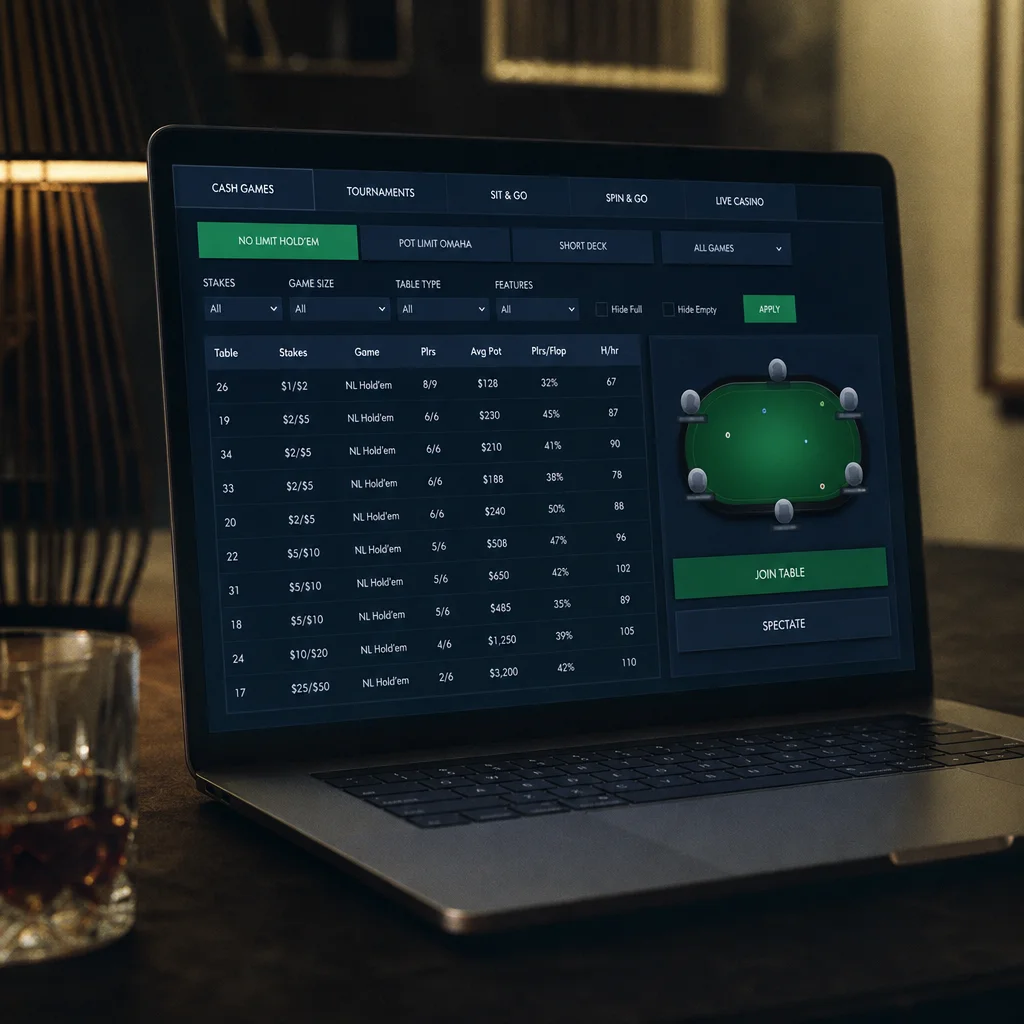
Roughly six in ten online poker hands worldwide get dealt through PokerStars at any given hour, and that scale is exactly why mixed-game players end up there instead of a niche site with an empty lobby. This pokerstars review looks specifically at what happens once you click past No-Limit Hold'em: how deep the HORSE, razz pokerstars, and Badugi tables actually run. If you already play Hold'em and just want cash game traffic, that's a different page entirely. Here the question is narrower — can PokerStars keep a mixed-game table full at 2 a.m. on a Tuesday, and is it worth signing up for that alone?
Affiliate Disclosure
I logged into the mixed-game tab at different hours over two weeks — early European mornings, US prime time, and the dead Tuesday afternoon lull — and the pattern held every time. PokerStars isn't just the biggest room by headline traffic; it's the only major site where a HORSE or Razz table reliably fills without a wait.
Ready to Find a Mixed-Game Table?
PokerStars runs the deepest HORSE, Razz, and Badugi spread of any major room we tested.
Visit PokerStars NowHow Deep Is the Mixed-Game Spread on PokerStars
PokerStars still runs the widest mixed-game menu of any licensed operator, which is why niche-variant players stick around. You'll find HORSE, Razz, Badugi, 2-7 Triple Draw, and Stud dealt as standalone games, not folded into a rotation you must opt into. Stakes run thinner than Hold'em, but a PokerStars account gets you a seat most competitors can't fill.
- HORSE — rotates Hold'em, Omaha Hi-Lo, Razz, Stud, and Stud Hi-Lo every set number of hands
- Razz pokerstars tables — Stud played for low, spread daily at micro and low stakes
- Badugi — a four-card lowball draw game, available but thinner in ring games
- 2-7 Triple Draw — draw-lowball, in both cash games and scheduled tournaments
- Mixed-game tournament series — periodic HORSE and 8-Game events with bigger guarantees
What HORSE Actually Feels Like at the Tables
HORSE rotates through Hold'em, Omaha Hi-Lo, Razz, Stud, and Stud Hi-Lo, usually every eight or ten hands. That rotation is what makes HORSE demanding — you can't lean on one skill set all session. In my experience, the biggest adjustment for Hold'em regulars is Razz, since it's played for low only, and high-hand instincts actively work against you.
If you're wondering how to play horse on pokerstars specifically, the software handles the rotation automatically — you don't select games manually mid-session. You post a bring-in or blind depending on which game is live, the client labels the current variant clearly above the table, and betting structure adjusts to fixed-limit rules, which is standard for HORSE everywhere, not just here.
Razz and Badugi: The Draw and Lowball Corner
Razz is Stud played purely for the lowest hand, and it's the variant PokerStars spreads most reliably outside HORSE — standalone razz pokerstars ring games run at low stakes most hours. Badugi runs thinner. It's a four-card draw game where the goal is the lowest unpaired, mixed-suit hand, and tables can go quiet outside peak hours.
For anyone asking how to play badugi pokerstars for the first time: each player gets four cards, draws up to three times, and the best badugi — four cards, four suits, lowest ranks — wins at showdown. It's a fast, cheap way to learn a new format, and I'd suggest starting at the lowest stakes since the hand-reading skill doesn't transfer from any other game you already know.
- Deepest mixed-game menu of any licensed room tested — HORSE, Razz, Badugi, and Triple Draw run daily
- HORSE and Razz tables fill even off-peak, unlike most competitor sites
- Regular mixed-game tournament series with bigger guarantees than daily ring games
- Long-established, regulated operator with clear verification and withdrawal processes
- Badugi liquidity thins out outside US and European peak hours
- Mixed-game stakes cap lower than Hold'em
- PLO or short deck depth is better covered by our GGPoker review
Playing Texas Hold'em for Real Money on PokerStars
Mixed games are the draw here, but most readers will still spend part of their bankroll on Hold'em. Learning how to play texas holdem for real money starts with picking a stake that matches your bankroll — a common guideline is 20-30 buy-ins for cash games. PokerStars runs stakes from micro ($0.01/$0.02) up through high-stakes tables, so moving from free play to real money doesn't mean jumping into deep water.
Bankroll Tip
PokerStars remains the safer default for real-money Hold'em because of its licensing footprint and long operating history. If your priority is PLO or short deck depth instead, our GGPoker review covers that traffic in more detail — PokerStars is the stronger pick for HORSE, Razz, and Badugi specifically.