
Five Card Draw: Rules, Draws and Betting Rounds
Nearly every poker player learns five card draw before anything else — it's the game dealt in classic Western films and home games long before Texas Hold'em existed. Five card draw is a poker variant where each player gets five private cards, then trades some for new ones in a single draw round before a final bet. This article covers the deal, the draw, the betting structure, and why the game has faded from casino floors. For how it compares to other formats, see our poker variants guide.
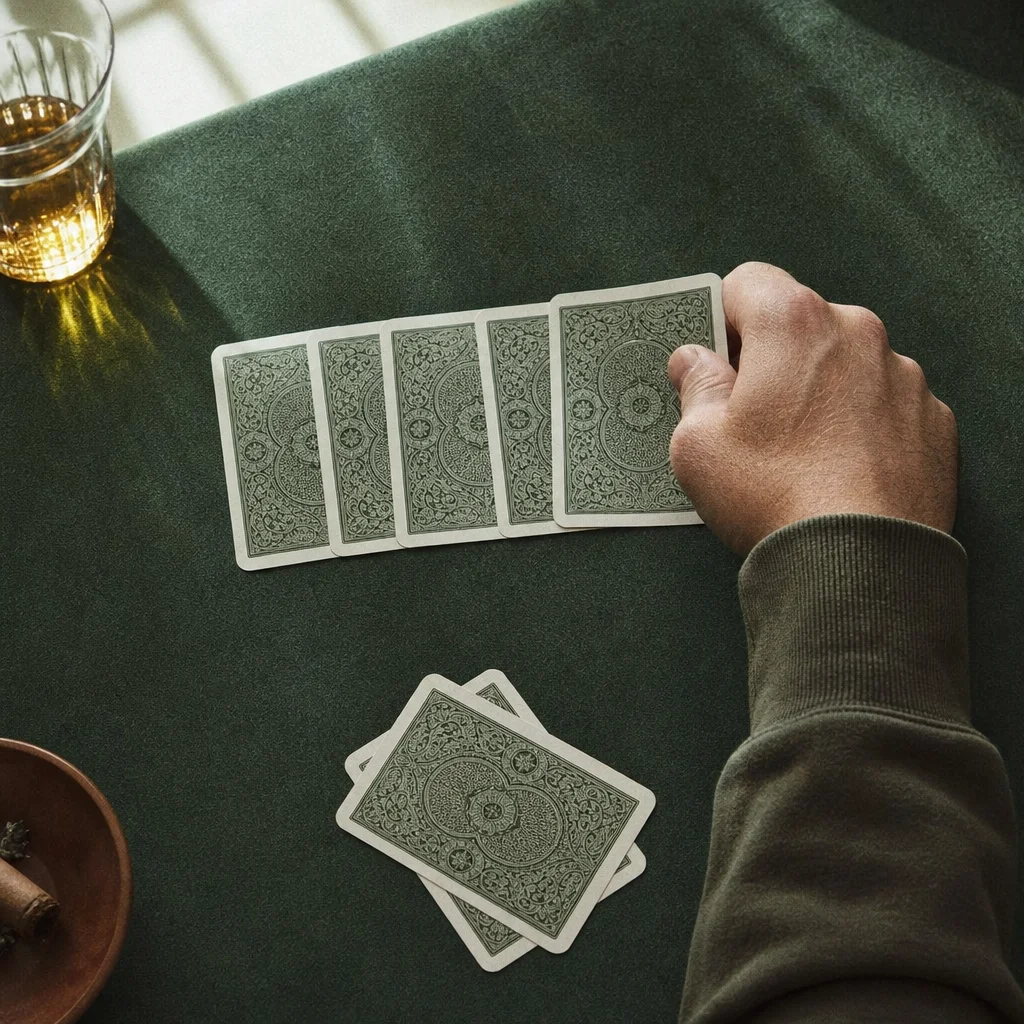
Each player is dealt five cards face down, with no community cards, so hand strength stays entirely private. A betting round follows the deal, then each remaining player may discard cards and receive replacements in the one draw round the game allows. A second and final betting round follows before the showdown. If you already know standard high-hand rankings, five card draw simply asks you to build the best five-card hand from what you draw into.
How a Hand of Five Card Draw Works
The dealer gives each player five cards face down, and a betting round starts before anyone changes their hand. Players check, bet, call, raise or fold based on their starting five cards. Once betting settles, each remaining player discards up to three cards (four with an ace) and draws replacements.
- Deal — five cards face down, no community cards
- First betting round — act on the original five cards
- The draw — discard up to three cards (four with an ace)
- Second betting round — final action after the draw
- Showdown — best five-card hand wins the pot
The Draw Round Explained
Five card draw has exactly one draw round, which separates it structurally from stud and community-card games entirely. During the draw, a player facing two pair might swap one card chasing a full house, while a player holding four cards to a flush swaps the fifth. Say a player holds three sevens and two unrelated cards — discarding both and drawing two fresh ones gives the best shot at trips becoming quads or a full house. That single decision is where most of the game's skill lives.
Ante, Blinds and Betting Structure
Some tables use an ante from every player before the deal, while others use small and big blinds like hold'em. Either structure funds the pot before cards are seen, usually a house-rule choice rather than a strategic one. Betting can run as limit, pot-limit or no-limit, and that affects the draw round more than it does in flop games, since a big raise can price opponents out of chasing a hand.
Betting Structure Matters More Here
Checking is allowed the same way it is in any structured betting round — if no one has bet yet, a player can check instead of committing chips, and action moves to the next seat. Checking through both rounds is uncommon once players show willingness to bet, since a checked pot before the draw often signals weak holdings across the table.
Why Five Card Draw Faded From Popularity
Five card draw dominated home games and Western saloons for decades, yet it's largely absent from modern casino floors and online lobbies. The core reason is information: hidden hands and just one draw round give opponents far less to read than stud or flop games, making deep strategy harder to teach and less compelling to broadcast. Texas Hold'em's shared community cards created easy storylines for the 2000s poker boom, and five card draw couldn't compete for screen time.
Five card draw also rewards a narrower skill set than modern spread games. With only one draw, players can't adjust across multiple streets the way they do in hold'em, so a strong player's edge shows up more slowly. That's part of why low-hand draw strategy — reading a lowball hand's inverted rankings — lives on its own page; see our Badugi guide for that variant. If you want stud's face-up dealing mechanics, our seven-card stud guide covers exposed cards and bring-ins.
None of this means five card draw is a bad game to learn — its simplicity makes it a good entry point before tackling stud or flop variants. Some tools built for other formats still apply loosely here: software like NZT Poker, for example, is built around real-time hand analysis for club-app cash games rather than draw poker specifically, so it's worth treating as one option among several. Working through practice hands on paper is usually the faster path to understanding the draw round. For the canonical rule set, see Pagat's five-card draw rules.
Comparing Poker Variants?
See how five card draw stacks up against other poker formats.
Explore the Variants GuideDisclosure: This page contains affiliate links. We may earn a commission at no extra cost to you.