
Chinese Poker: Rules, Scoring and Royalties
Chinese poker splits thirteen cards into three separate hands, and it rewards the player who sets those hands better than anyone else at the table. If you already know standard five-card hand rankings, you're most of the way there — the rest is learning how three rows, royalty bonuses and the surrender rule fit together. I've played this game in home cash sessions for years, and the scoring system trips up more beginners than the hand-setting does. For players who study the math between sessions, NZT's poker variants guide is one option worth exploring.
What Is Chinese Poker?
Chinese poker is a card game for two to four players in which each player gets thirteen cards and arranges them into three hands: a five-card back hand, a five-card middle hand, and a three-card front hand. Unlike Hold'em or Omaha, there's no community board or betting during the deal — the game happens entirely through hand-setting and comparison. Players score points by beating opponents' rows, and royalties reward strong hands.
How to Play Chinese Poker
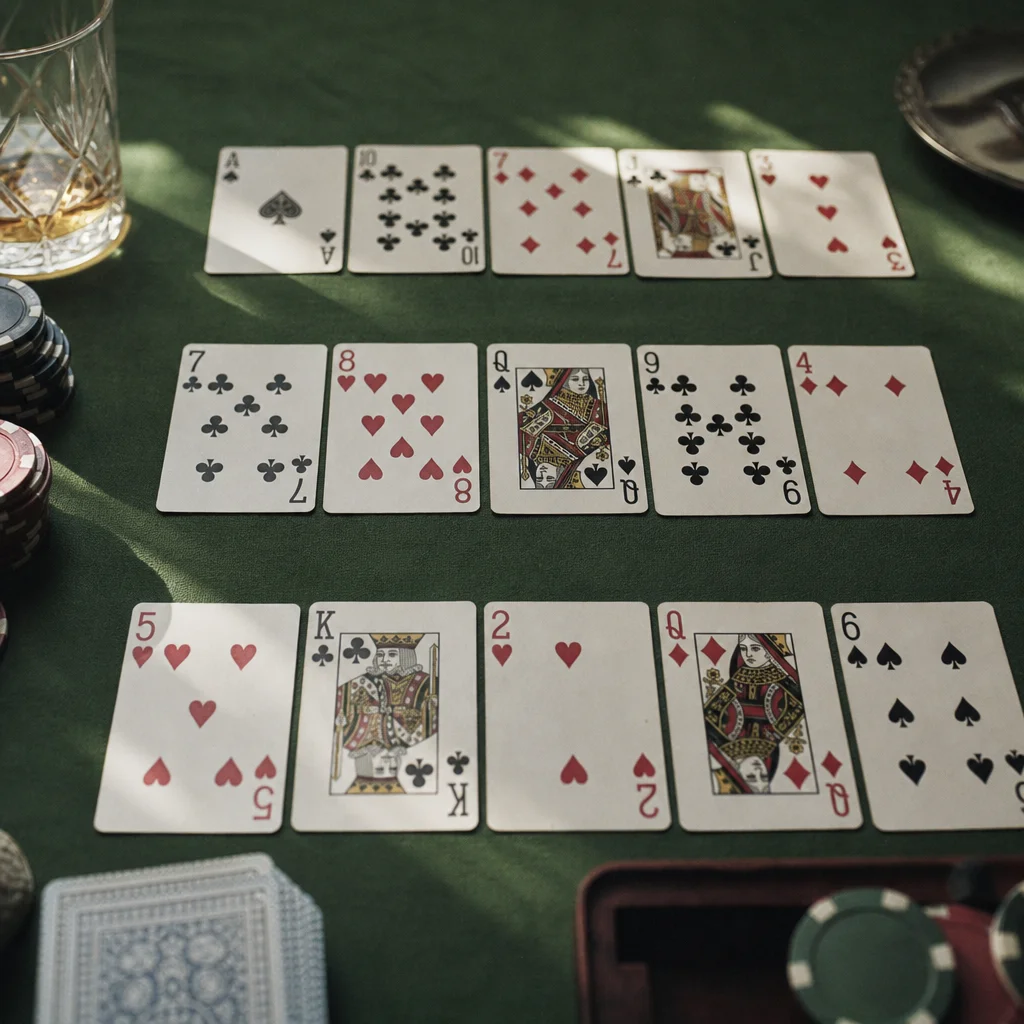
In chinese poker, each player gets thirteen cards and privately arranges them into the back, middle and front hands. The back hand must rank highest, the middle second, and the front lowest — a rule beginners break most often. You can't set two pair in your front hand and a lower two pair in your middle hand; the middle must always outrank the front, and the back must outrank the middle.
Once every player sets their three rows, hands are revealed and compared row by row against each opponent. You win or lose points on each row independently, so you can win your back hand against one opponent while losing your front hand to another. This closed-hand format — seeing only your own thirteen cards before setting — is what separates classic chinese poker rules from open-face Chinese, which reveals cards one at a time and adds a Fantasyland bonus round.
Chinese Poker Scoring and Royalties
Basic chinese poker scoring uses a simple unit system: winning a row earns one unit, losing a row costs one unit. Beat an opponent on all three rows and you typically collect a scoop bonus, which usually doubles the points for that matchup. Your final score is the sum of three separate two-player row comparisons.
Royalties add extra points on top of basic unit scoring whenever a row qualifies. A full house or better in the back hand, a flush or better in the middle hand, or trips in the front hand typically trigger a royalty bonus. This is why chinese poker hands are worth setting carefully — a strong row can swing extra units even in a losing matchup.
| Row | Minimum Qualifying Hand | Typical Royalty Range |
|---|---|---|
| Front (3 cards) | Trips | 10-22 pts |
| Middle (5 cards) | Full house | 2-30 pts |
| Back (5 cards) | Full house | 1-25 pts |
Surrender Rule and Bombs Explained
Most home games allow a surrender option: if your initial thirteen cards look unplayable, you can fold before setting your rows and pay a small fixed penalty instead of risking a bigger loss. It's a safety valve, though experienced players surrender less often than beginners expect. A bomb is a premium natural hand dealt in the original thirteen cards — commonly four of a kind or better — that pays out at a fixed, elevated point value against every opponent regardless of how they set their rows.
Avoiding a Foul
Chinese Poker Variants and Learning Resources
Classic chinese poker is the closed-hand version above, but it's not the only way people play. Open-face Chinese, or OFC, deals cards one at a time and adds Fantasyland — a different structure worth reading up on separately. Away from the table, players study hand combinations using solvers or simple practice, and some track sessions with a poker tracker. Whichever tools you use, the fundamentals stay the same: know your rankings cold, and think one row ahead. For the canonical rule set, see Chinese poker.
Curious How Poker Variants Compare?
If you want a side-by-side look at Chinese poker versus other formats, this guide is one option worth exploring.
See the Poker Variants GuideDisclosure: This page contains affiliate links. We may earn a commission at no extra cost to you.