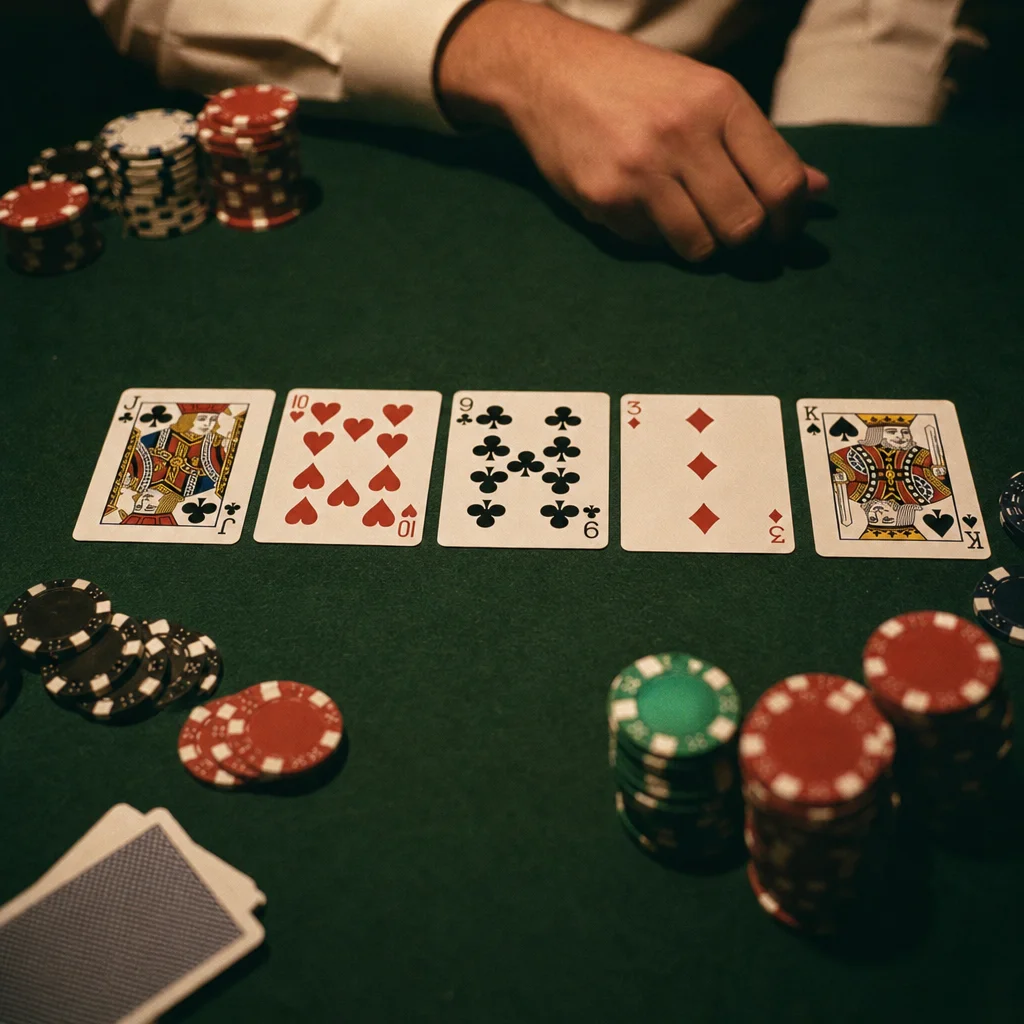

Open Face Chinese Poker: Pineapple, Points & Fantasyland
Open face chinese poker is the branch of Chinese poker where you place cards one at a time and can't rearrange them afterward — a rule that changes the whole game. You already know how the three rows score; open face is where that scoring meets a sharper decision problem, since one misplaced card can foul your entire hand. For a couple of tools some players use to study tricky spots, this poker variants guide covers a few. The closed-hand version with card-setting and bombs lives on our dedicated Chinese poker page — this one stays on open face.
Sequential Placement: the Core Difference
In standard Chinese poker, you see all 13 cards at once and set your rows in one move. Open face flips that: you place five cards first, one at a time into the top, middle, or bottom row, then keep placing new cards immediately as they arrive, with no going back.
Fouling Risk in Open Face Chinese Poker
A foul happens when your bottom row doesn't outrank your middle, or your middle doesn't outrank your top — the same rule from row scoring, but now a live risk on every placement. Foul your hand and you typically lose all three rows to every opponent, plus any royalties you'd otherwise earn. In my experience, the biggest leak new players have is stacking the top row too strong, too early.
How Open Face Chinese Points and Royalties Work
Open face chinese points combine two things: the standard point-per-row result against each opponent, plus royalty bonuses for strong hands in a specific row. Queens or better on top, a straight or better in the middle, and a full house or better on the bottom typically earn royalties. Scoop bonuses — winning all three rows — add further points in most rulesets.
Quick Royalty Reference
Open Face Chinese Pineapple: the Faster Variant
Open face chinese pineapple is the format most online rooms actually spread. Instead of one card per turn, you're dealt three cards at a time and must place two, discarding the third — adding a layer plain open face doesn't have: choosing which card to keep, not just where it goes.
Fantasyland: Open Face Chinese Fantasy Explained
Open face chinese fantasy — Fantasyland — is the reward mode earned by getting a strong hand on top, usually queens or better, without fouling. Once you qualify, your next hand is dealt all 13 cards at once, letting you arrange the entire hand in one move instead of placing one card at a time.
Practicing and Sharpening Open Face Decisions
Most players improve by reviewing hands after the session rather than solving everything live, since placements come fast at the table. A notebook or simple spreadsheet works for logging unsure spots. Some players instead lean on real-time assistance software that suggests a placement live at the table — NZT Poker is one example, built for the Asian club-app ecosystem rather than solved-game study. It's worth knowing this kind of in-hand tool is against the rules on the platforms it supports, so treat it as a trade-off — assistance during the hand for account risk — rather than a training method.
- Keep your top row conservative early — you can't undo a placement once it's down
- In pineapple, judge each three-card deal by what it protects, not just its face value
- Log any hand where you weren't sure about a placement and review it later
Open face chinese poker rewards patience with placement more than raw hand-reading skill. Once you're comfortable with royalty points, pineapple's discard decisions, and the path into Fantasyland, the sequential structure starts to feel like the interesting part of the game rather than a restriction on it. For the canonical rule set, see open-face Chinese poker.
Want More Poker Variant Breakdowns?
A rundown of variant rules and scoring, including more on the open face branch.
See the Poker Variants GuideDisclosure: This page contains affiliate links. We may earn a commission at no extra cost to you.